Love Ladder Strategy: 4 Hints for Five Couples (Stage 190)
 Love Ladder The JoyPlus Soft Planning Team
From stage 175 on, every board in Love Ladder has five couples and about six pieces, and nine boards in ten have a row with three or more pieces side by side. Two neighbours do not simply add up: an animal can run from one piece straight into the next. This guide works through one real board, Stage 190, and shows four hints that make side-by-side pieces easy to read. The middle order between the two rows, which we use right away, is explained in the beginner guide.
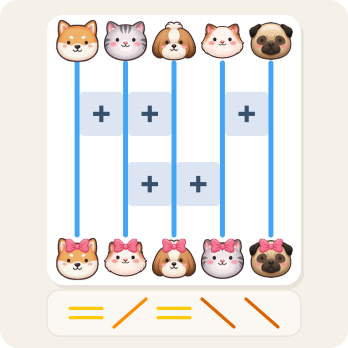
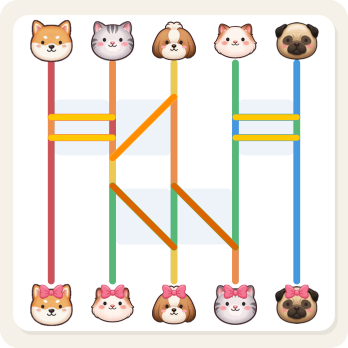
The lines are numbered 1 to 5 from the left. The goal: the Shiba Inu stays on line 1, the Shih Tzu stays on line 3 and the pug stays on line 5. The grey kitten has to get from line 2 to line 4, and the cream cat from line 4 to line 2.
Hint 1: Two pieces side by side never leave everyone in place
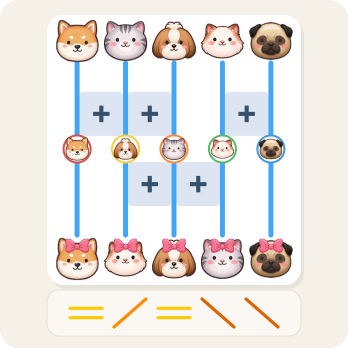
Start with the easy part. The bottom row only touches lines 2 to 4, so the Shiba and the pug must already be on lines 1 and 5 when they leave the top row. The pug starts on line 5, so the lone slot between lines 4 and 5 in the top row must not swap anything, and the cream cat stays on line 4 as well.
That leaves the two slots side by side on the left of the top row, covering lines 1 to 3. Here is the useful fact: two neighbouring pieces always move somebody. We checked all 20 pairs the game allows, and none of them leaves all three animals where they were. The Shiba on line 1 has to stay, so the only thing this pair can do is swap the other two. After the top row the Shih Tzu is on line 2 and the grey kitten on line 3.
Hint 2: A double bar rests unless a single bar is next to it
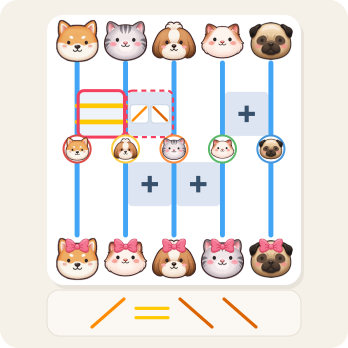
The top pair must keep the Shiba on line 1. A diagonal on the left would always carry the Shiba away, so the left slot needs a piece that rests, and the only one in this tray is the double bar. On its own, a double bar is a quick trip over and back. It keeps doing exactly that next to a diagonal or a cross: in every row of up to four pieces we checked, a double bar with no single bar beside it behaves as if its slot were empty. Next to a single bar it is a different story, the two together turn three animals around.
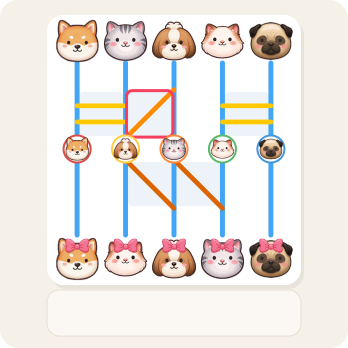
With the double bar resting, the slot beside it just has to swap the grey kitten and the Shih Tzu. Either diagonal does that, so we leave it open for now.
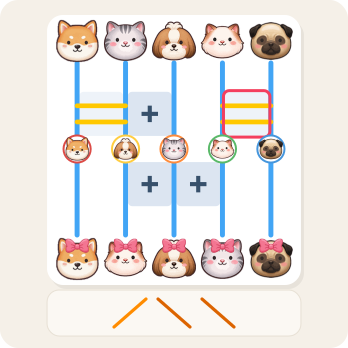
This is the beginner hint again: a slot on its own swaps or does nothing, and here nothing must happen.
Hint 3: A diagonal sends an animal from one end to the other
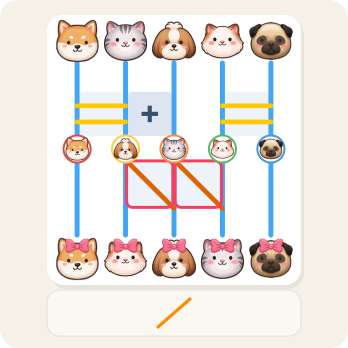
In the bottom row the Shih Tzu on line 2 must go to line 3, the grey kitten on line 3 to line 4, and the cream cat on line 4 all the way to line 2. That is the signature move of a diagonal down with a partner: when it sits next to a single bar, a cross or another diagonal down, the animal on the right end slides to the left end and the other two each step one place right. A diagonal up does the mirror image: the left end goes to the right end.
The pieces left are a diagonal up and two diagonals down, so the pair has to be the two diagonals down.
Hint 4: A diagonal up and a diagonal down never sit side by side
Why not a diagonal up next to a diagonal down? The game does not allow it. Their ends would meet at the same point on the shared line, so the piece will not drop in. That rules out every mix of the two in the bottom pair, and the diagonal up goes into the top row.
Pairs at a glance
These are all 20 pairs the game lets you place side by side, worked out with the game's own rules. Keep the list handy, it is most of what you need for five couples.
- Double bar next to a diagonal or a cross: the double bar rests and the other piece swaps its two animals.
- Double bar next to a single bar: the three animals turn around, so the first and the third trade places.
- Single bar next to a cross: the single bar rests and the cross swaps its two animals.
- Diagonal up with a single bar, a cross or another diagonal up: the left animal goes to the right end, the other two shift one place left.
- Diagonal down with a single bar, a cross or another diagonal down: the right animal goes to the left end, the other two shift one place right.
- Not allowed side by side: two single bars, two double bars, two crosses, a diagonal up next to a diagonal down.
Habits that help
- Fix the animals on lines a row does not touch first. They give you the middle order cheaply.
- If one end of a pair has to stay, the other two swap. A pair never does nothing.
- Double bars rest next to anything but a single bar. Use them to keep an animal still.
- An animal travelling two lines in one row means a diagonal: down for right to left, up for left to right.
- Check the neighbour rules before you count pieces. They often decide which row a piece belongs to.
Next guide
Guides for other puzzles