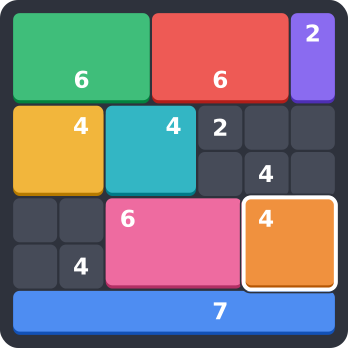
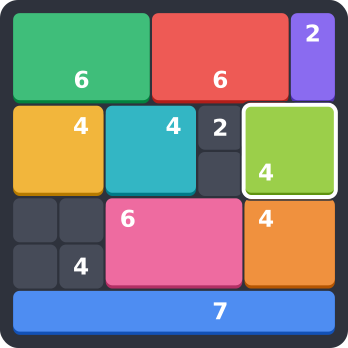
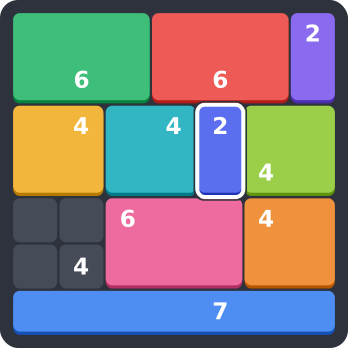
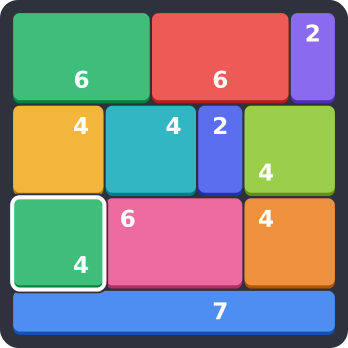
Every Kaku board has exactly one answer, and you can reach it without guessing. Instead of listing tips, let's solve one real board from the game together: Easy 88. Four hints come up along the way, in the order you need them, and you will use the same four on every board after this one.
The rules
Kaku follows the classic rules of Shikaku, the Japanese rectangle puzzle:
Split the whole grid into rectangles (squares count too), with no gaps and no overlaps.
Every rectangle contains exactly one number.
The number is the size of its rectangle. A 6 covers 6 cells, as 2 x 3 or 1 x 6.
To place a piece, drag from one corner of the rectangle to the opposite corner. While you drag, a small badge shows how many cells you have covered. Let go to place it. If it breaks a rule (no number, two numbers, the wrong size or an overlap), it flashes red and is not placed. Tap a placed piece to remove it.
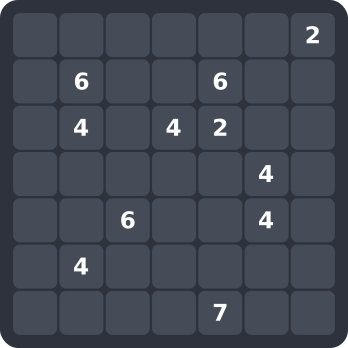
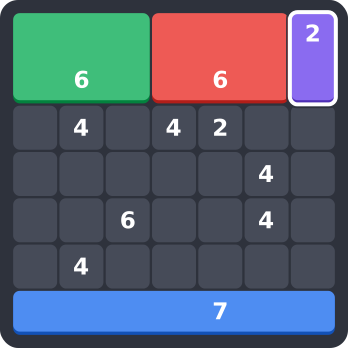
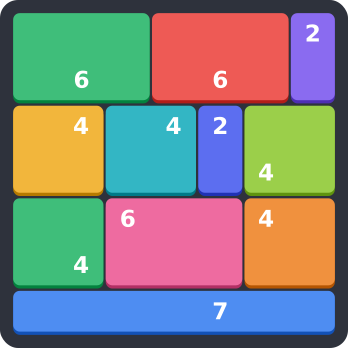
Easy 88. A 7 x 7 board with 11 numbers, so 11 rectangles.
Hint 1: Numbers that fit only one way
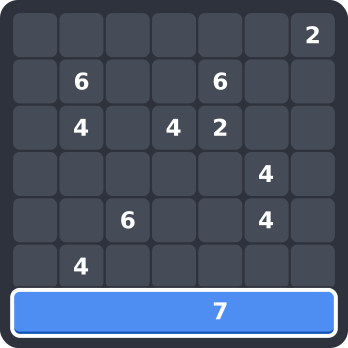
Seven cells can only make a straight line. Standing up, the 7 would fill the whole fifth column, which already holds a 6 and a 2. So it is the entire bottom row.
Before drawing anything, go over the numbers and ask how many rectangles each one could be. A prime number (2, 3, 5, 7) can only be a straight line, and a rectangle can never take in a second number, so numbers near an edge or close to other numbers often have just one shape left.
Hint 2: Who can reach the corner?
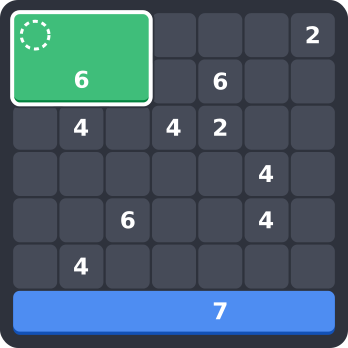
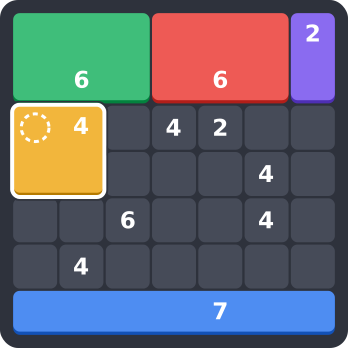
Only the 6 can reach the top-left corner. The 2 is too small, and every other number would have to cover the 6 to get there. Of the 6's shapes, only 2 rows x 3 columns covers the corner without taking in the 4 below.
Every cell has to end up inside some rectangle, and corners are the easiest cells to check. Look at a corner and ask which numbers could stretch that far. If only one can, its rectangle covers the corner, and often only one shape does that.
Hint 3: Each piece takes room from its neighbors
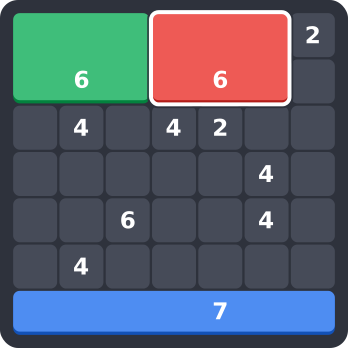
The other 6 could be 2 x 3 over columns 3-5 or columns 4-6. The green piece took column 3, so it is columns 4-6.
After every piece, look at the numbers next to it again. A number that had two or three shapes a moment ago may be down to one.
The 2 in the top-right corner could lie flat or stand up. The red piece took the cell to its left, so it stands up.
Hint 4: A cell only one number can reach
Look at the empty cell on the left edge, under the green piece. Any other number would have to cover the 4 next to it to get there, so that 4 covers it. The only 4-cell shape that does is 2 x 2.
Hint 2 works for any cell, not only corners. When you are stuck, pick an empty cell, especially one boxed in by pieces or the edge, and ask which numbers can reach it.
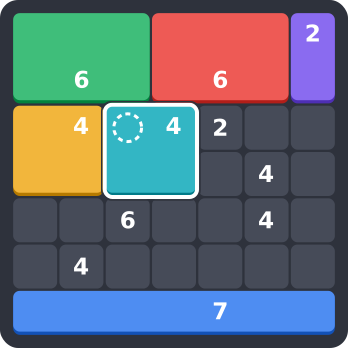
Same idea for the cell between the yellow piece and the next 4. Only that 4 can reach it, and only as a 2 x 2.
The rest is Hint 3
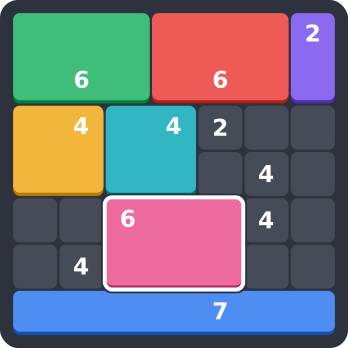
7. The 6 in the middle has one shape left.8. Then the 4 to its right.9. Then the 4 above that.10. The 2 can only go down.11. The last 4 fills the last four cells.
Solved: 11 rectangles, one number in each, and every cell covered.
Habits that help
Start with big numbers, prime numbers and numbers near the edges.
Remember that a rectangle can never hold two numbers. Other numbers block shapes just like the edge does.
After every piece, check its neighbors again (Hint 3).
Stuck? Pick an empty cell, starting with the corners, and ask which numbers can reach it (Hints 2 and 4).
Still stuck? The hint button places one correct rectangle for you.

 Kaku The JoyPlus Soft Planning Team