How to Solve Crossum: 4 Beginner Hints (Easy 38)
 Crossum The JoyPlus Soft Planning Team
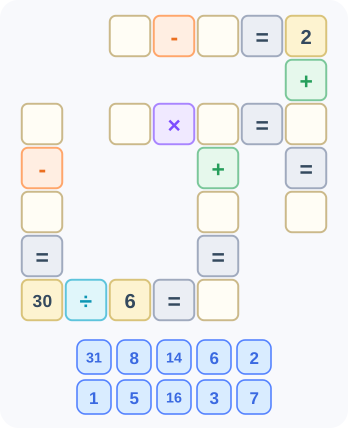
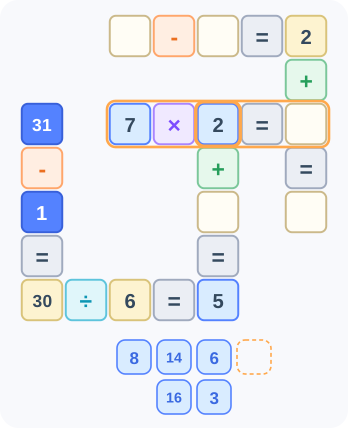
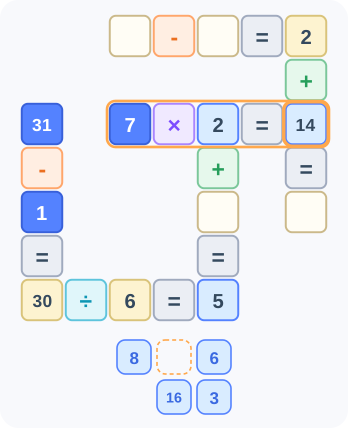
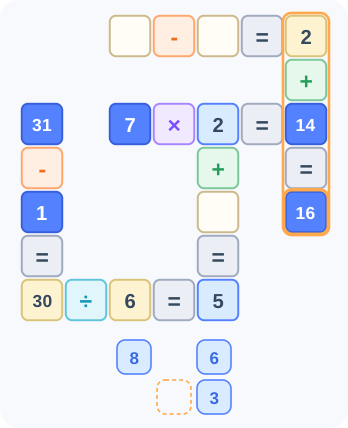
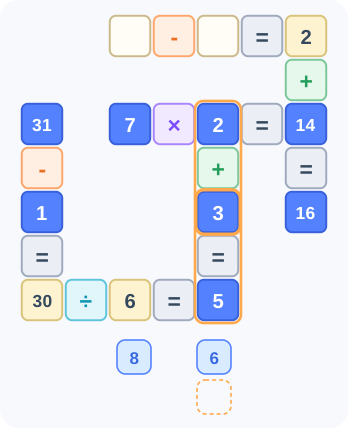
Crossum is a crossword made of sums. You can always drop numbers into cells and see what happens, but a wrong equation costs a heart. It works much better to find the cells you can be sure of and fill those one at a time. Let's do that together on a real board from the game, Easy 38. Four hints come up along the way, in the order you need them.
Crossum follows the same idea as other cross math and math crossword puzzles, so everything below works in those too.
The rules
- Every equation across and down, like A + B = C, has to be true. Where two equations cross, they share one number.
- Place the numbers from the tray at the bottom into the empty cells. There are exactly as many tray numbers as empty cells, and you have to use them all.
- Multiplication and division come before addition and subtraction. A subtraction never goes below zero, and a division always comes out even.
Tap a number and then an empty cell, or drag the number onto the cell. An equation is checked the moment its last cell is filled. If it is wrong, you lose one of your three hearts and the number you just placed goes back to the tray.
Hint 1: If only the result is missing, just calculate
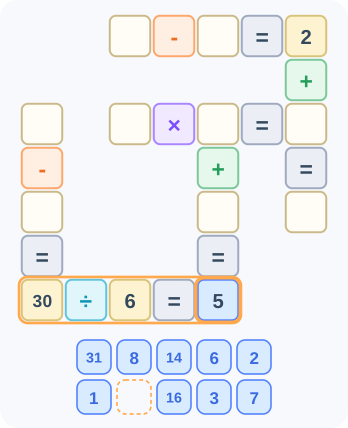
When the only empty cell in an equation is the result, there is nothing to think about. Scan the whole board for these first. The 5 we just placed is also the result of the short column above it (? + ? = 5), which gives that column a head start.
Hint 2: Look for a pair in the tray
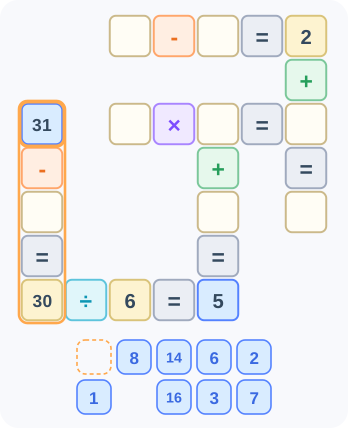
Two empty cells in one equation is not a dead end. Every answer is a tray number, so look for tray numbers that make the equation true. If only one pair works, both cells are settled at once. The rules help here: in a subtraction the bigger number comes first, and in a division only pairs that divide evenly count, so the list of pairs gets short quickly.
Hint 3: Work backwards from the result
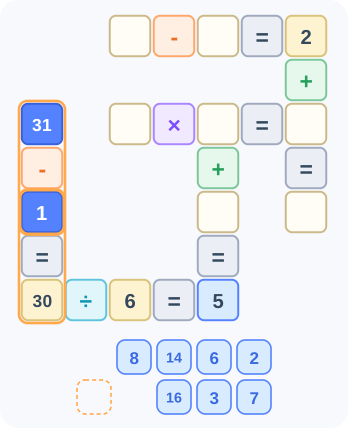
If one of the first numbers is missing and the result is there, undo the sum: for ? + 8 = 9 take 9 - 8, for ? × 4 = 20 take 20 ÷ 4. Together with Hint 1, this is the hint you will use most.
Hint 4: A number with only one place to go
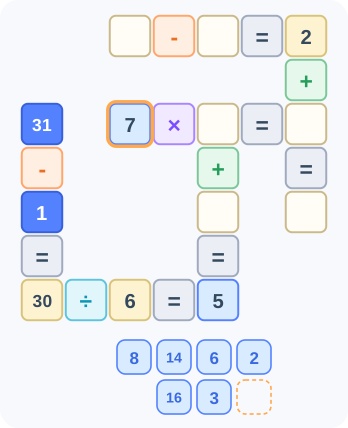
Every tray number has to be used, so you can also look from the number's side. If a number fits only one empty cell, that cell is its home. When the cells give you nothing, pick a large or awkward number and ask where it could possibly go.
The rest is Hints 1-3
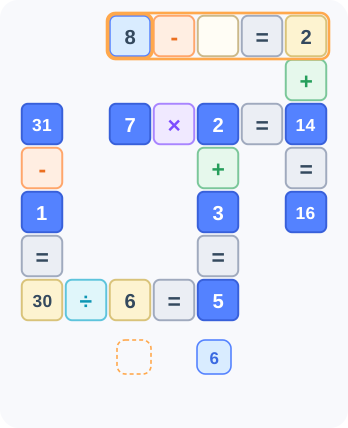
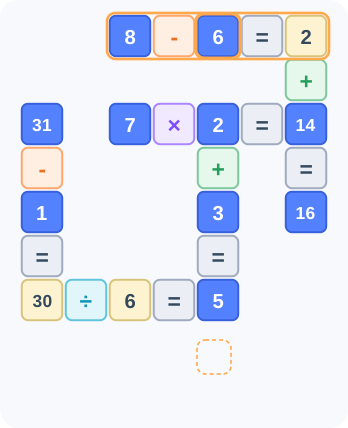
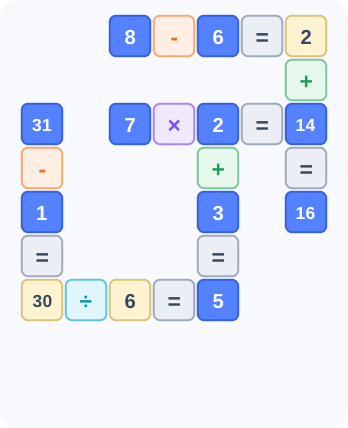
When there is more than one answer
Easy 38 has only one answer, which is why every step above could be worked out. Crossum also has boards with more than one. When we solved Easy 1-300 with the hints in this guide, 134 boards had a single answer and 166 had two or more, usually because two numbers can swap places. The game accepts any arrangement that uses every tray number and makes every equation true. The next guide shows how to handle those spots.
Habits that help
- Look before you place. Find the equations with only one empty cell first (Hints 1 and 3).
- For equations with two empty cells, look for a pair in the tray (Hint 2).
- When the cells give you nothing, look from the number's side: where could this number go (Hint 4)?
- Do not drop a number in just to see. A wrong equation costs a heart the moment its last cell is filled.
- If you are really stuck, the hint button reveals the answer for one empty cell.
Next guide
Guides for other puzzles