How to Solve a Nonogram: 4 Beginner Hints (Simple 7)
 Nonogram The JoyPlus Soft Planning Team
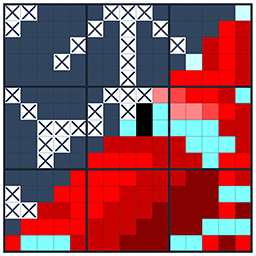
A nonogram never asks you to guess. Every square can be worked out from the numbers, one row or one column at a time. Instead of listing tips, let's solve one real board from the game together: Simple 7, a 10x10 picture. Four hints come up along the way, in the order you need them, and they are the same four you will use on every board after this one.
Nonograms go by many names, picross and griddlers among them, but the rules are the same everywhere.
The rules
- The numbers to the left of a row are the runs of painted squares in that row, from left to right.
- The numbers above a column are the runs in that column, from top to bottom.
- Runs are separated by at least one empty square. "2 7" means a run of 2, a gap, then a run of 7.
- When every row and column matches its numbers, the hidden picture appears in color.
Pick the check button to paint or the X button to mark, then tap a square, or drag along a line to do several at once. An X means "this square stays empty". It is only a note for you, but it is what makes the next move visible, so use it a lot. Rows are counted from the top and columns from the left.
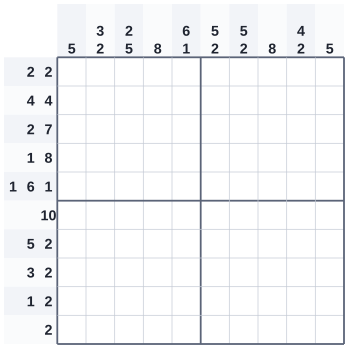
Hint 1: Lines the numbers fill completely
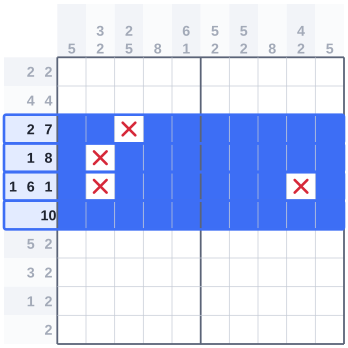
Add up the numbers in a line, plus one empty square between each pair of runs. If the total is 10, the line has no room to move. Row 3 is 2 + 1 + 7 = 10, row 4 is 1 + 1 + 8 = 10, row 5 is 1 + 1 + 6 + 1 + 1 = 10, and row 6 is simply 10. Paint them and put an X in each gap.
Hint 2: Big numbers overlap
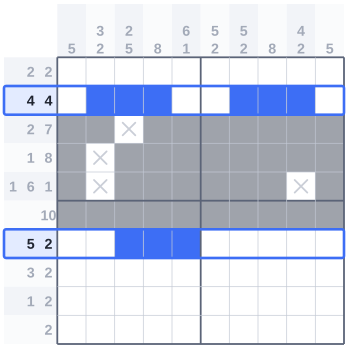
Row 2 needs 4 + 1 + 4 = 9 squares, one less than 10. Push both runs all the way to the left, then all the way to the right: each 4 moves by only one square, so its middle three squares are painted either way. Row 7 needs 5 + 1 + 2 = 8, so it has two spare squares. The 5 can slide by two, which still leaves its middle three (columns 3 to 5) painted. The 2 is no longer than the spare room, so it gives nothing yet.
Hint 3: Grow from the squares you know
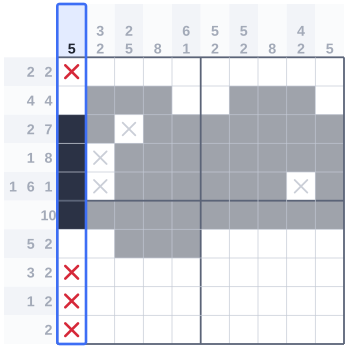
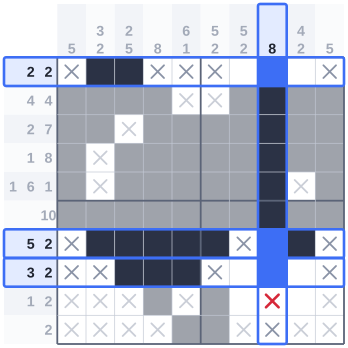
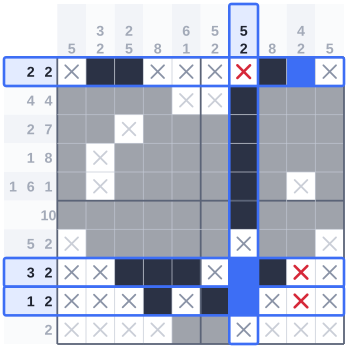
Once a line has painted squares or X marks, push its runs left and right again. This time a run cannot cross an X or the edge, and it cannot leave a painted square uncovered. Squares that every position covers are painted, and squares that no run can reach are X.
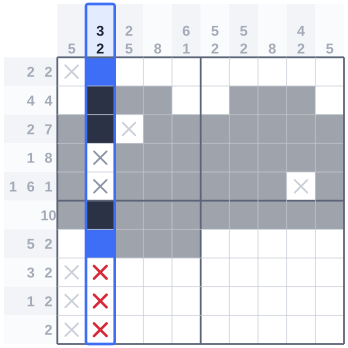
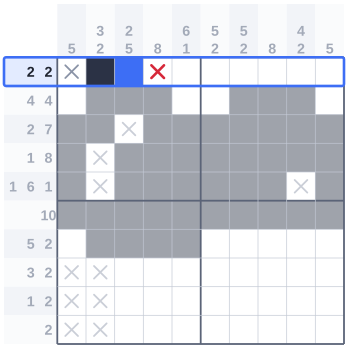
X marks also make a line shorter, and Hint 2 works on the part that is left.
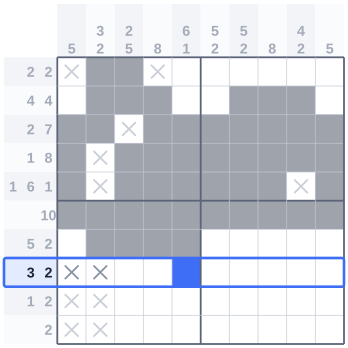
Keep going with Hint 3
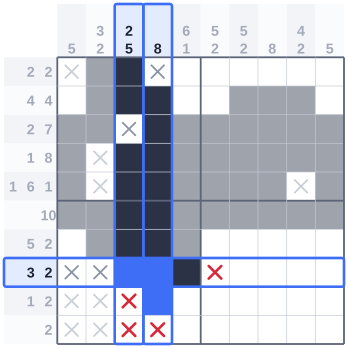
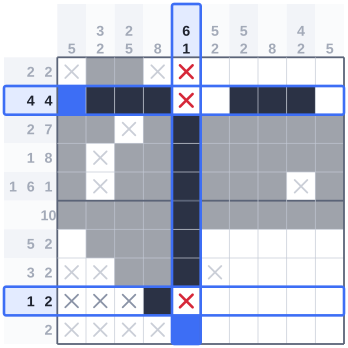
Hint 4: A finished line gets X
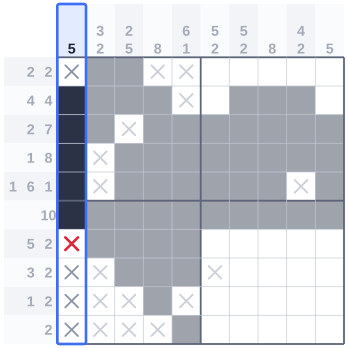
When a line has all of its runs painted, everything left in it is empty. It sounds obvious, but it is easy to forget, and those X marks are often what unlock the crossing lines.
The rest: Hints 3 and 4 again
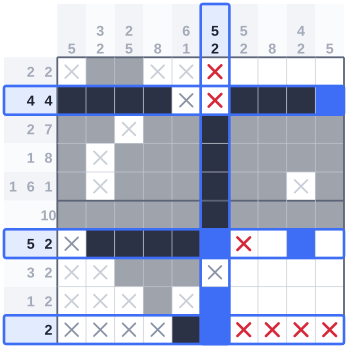
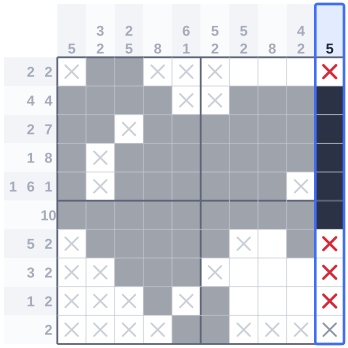

Habits for any nonogram
- Start with the biggest numbers. Add the numbers and the gaps and compare the total with the line length (Hints 1 and 2).
- Mark X as soon as you know a square is empty. X marks shorten lines and open new moves.
- After every change, look at the crossing lines. A new square in a row is new information for its column.
- When a line is finished, fill the rest with X (Hint 4).
- Never guess. If nothing moves, look for a line where pushing the runs left and right gives something (Hint 3).
Next guide
Guides for other puzzles