How to Play How Many Pals?: A Minesweeper-Style Logic Puzzle, Solved Step by Step (Living Room, Puzzle 1)
 How Many Pals? The JoyPlus Soft Planning Team
How Many Pals? is a number logic puzzle, and if you have played minesweeper, the idea will feel familiar: numbers on the board tell you how many of something are around them, and you work out the rest from those numbers. The difference is in what gets counted. There are no hidden mines. Every square holds a pet, the numbers sit on pets, and each pet counts only friends of its own kind, in its own way. A cat counts the 8 squares around it, just like a minesweeper number, but a hamster only looks up, down, left and right. And where classic minesweeper sometimes leaves you with a coin flip, every board here can be finished by logic alone.
Instead of a list of tips, let's solve one real board together: Living Room, Puzzle 1, the very first board in the game. It is a 4x4 board with only cats and hamsters, and two hints are enough to finish it. You will use the same two on every board after this one.
The rules
- Every square holds exactly one pet. On this board, that means a cat or a hamster.
- Some pets start on the board with a number in a speech bubble. The number is how many friends of the same kind that pet counts.
- A cat counts cats in the 8 squares around it. A hamster counts hamsters only in the 4 squares directly up, down, left and right.
- Later chapters add rabbits (the 4 diagonal squares), dogs (straight lines, until another pet blocks the view) and line counts.
Choose a pet from the row at the bottom, then tap an empty square to place it. A wrong pet costs one of your three hearts, and the square then shows the pet that really belongs there. If you are not sure, press and hold a square to leave a memo, which costs nothing. Tapping a pet with a number lights up the squares it counts.
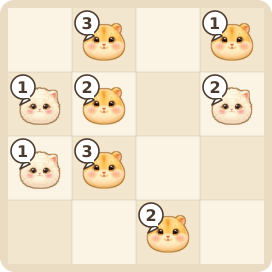
How cats and hamsters count
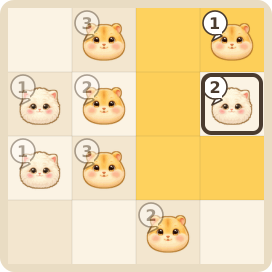
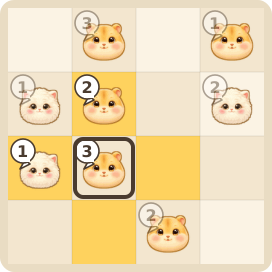
So the 3 on this hamster means that 3 of those 4 squares are hamsters. Pets of the other kind are never counted, and a pet does not count itself.
Hint 1: When the number matches the empty squares
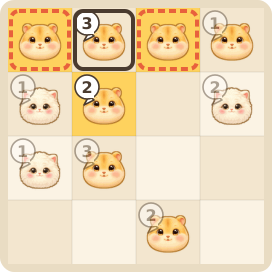
This is the first thing to look for on any board. Take the number, subtract the friends of that kind that are already there, and compare what is left with the empty squares the pet counts. If they are equal, every one of those empty squares is that pet. Minesweeper players know this move: a number with exactly that many unopened squares left around it means they are all mines.
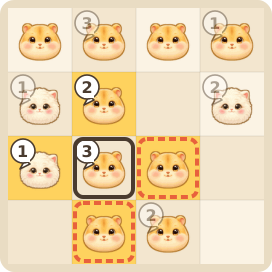
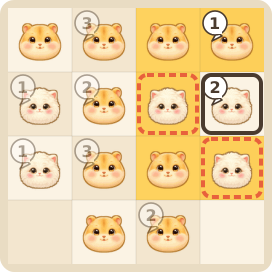
This move only became possible because of the hamsters placed before it. Every pet you place changes the count for its neighbors, so after each step, look again at the numbers next to it.
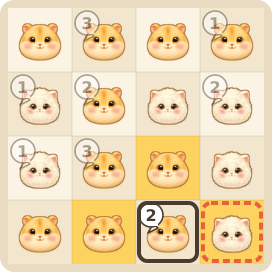
Hint 2: When the number is already reached
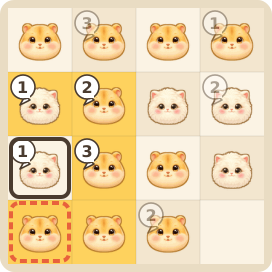
This is the other half of minesweeper's basic logic. When a number already has all the friends it needs, the rest of its empty squares are not that pet. With only two kinds of pet on the board, not a cat means a hamster, and the other way round.
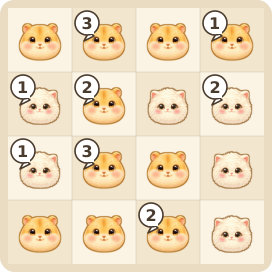
What to remember
- Every square gets one pet, and a number counts only friends of its own kind.
- Check who is counting first: a cat looks at 8 squares, a hamster at 4.
- If the number minus the friends already there equals the empty squares it counts, they are all that pet.
- If the number is already reached, its other empty squares are not that pet.
- After each pet you place, look at the numbers around it again.
Bigger boards bring rabbits, dogs and line counts, and sometimes you have to read two numbers together. The next guide shows that move, the one minesweeper players use most, on a 5x5 board.
Next guide
Guides for other puzzles