If you know minesweeper, you already know most of what How Many Pals? asks of you. This guide takes the three basic minesweeper deductions and shows each one at work on one real board: Living Room, Puzzle 11, one of the harder 5x5 boards in the first chapter.
The first chapter is the closest the game gets to minesweeper. It has only two kinds of pet, so think of the cats as the mines. A cat's number is the number of cats in the 8 squares around it, exactly like a minesweeper number. The one difference is that the number sits on a cat instead of an empty square. Hamsters count hamsters, and only in the 4 squares up, down, left and right. Since every square that is not a cat is a hamster, a hamster's number also tells you how many cats are beside it.
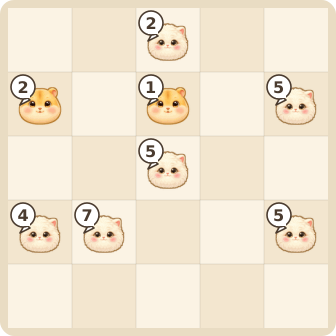
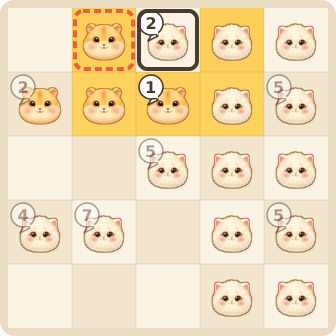
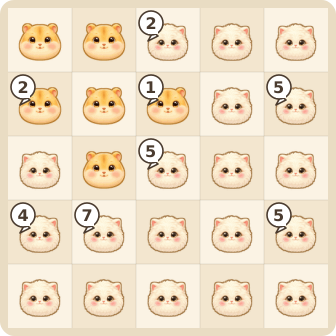
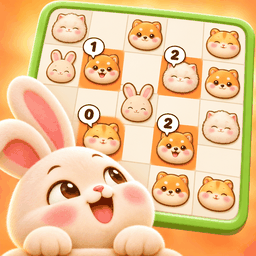
Living Room, Puzzle 11. Eight numbered pets and seventeen empty squares. White pets are cats and orange pets are hamsters.
Move 1: The number equals the unopened squares
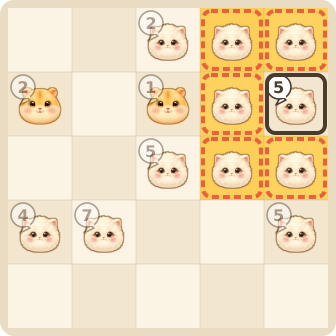
The cat with a 5 in the second row, on the right edge, has only 5 squares around it, and none of them is filled yet. 5 cats are needed and 5 squares are empty, so all five are cats.
In minesweeper, a number with exactly that many unopened squares around it means every one of them is a mine. Here it means every one of them is that pet. Corners and edges are the best places to start, because pets there count fewer squares.
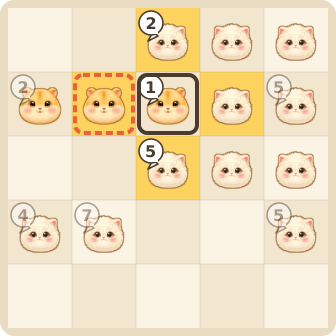
The hamster with a 1 needs one hamster on its four sides. The squares above and below it are cats, and the one on its right just became a cat, so the square on its left must be the hamster.The cat with a 5 in the fourth row, also on the right edge, already has 2 cats among its 5 squares thanks to the first move. It needs 3 more, and exactly 3 squares are empty. All cats.
Subtract what is already there before you compare. Minesweeper players do the same when a number already touches some flagged mines: what matters is how many are still missing.
Move 2: A number that is already full
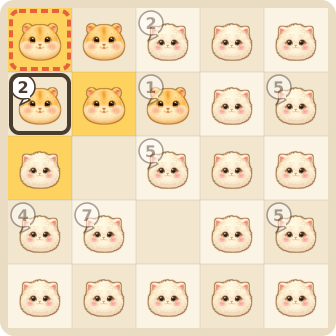
The cat with a 2 in the top row already has 2 cats around it, both on its right side. The count is full, so the empty square on its left is not a cat. That makes it a hamster.
This is minesweeper's other basic move: when a number already has all its mines, every other square around it is safe. Here, safe means not this pet, and on a cats-and-hamsters board that settles the square.
Move 3: Compare two numbers that share squares
Now the board gets stuck. No single number decides any square on its own, and this is exactly the point where minesweeper players start comparing neighboring numbers.
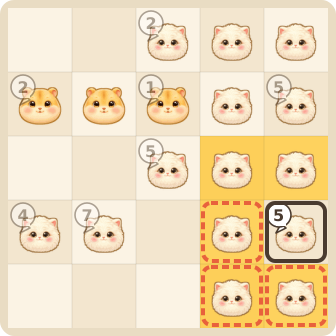
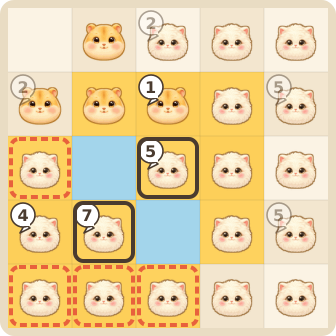
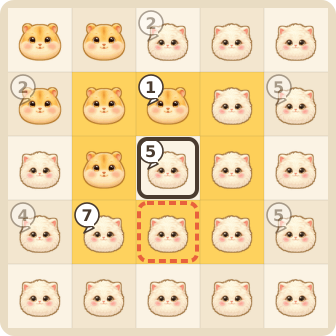
The cat with a 5 in the middle already has 4 cats around it, so exactly 1 of the two blue squares is a cat. The cat with a 7 below and to its left needs 5 more cats among its 6 empty squares, and those include the same two blue squares. They can hold only 1, so the other 4 squares are all cats.
This is the subtraction trick from minesweeper. When all the empty squares of one number sit inside another number's squares, take what the smaller one is still missing away from what the bigger one is still missing, and the difference belongs to the squares outside the overlap. Here 5 minus 1 leaves 4 cats for exactly 4 squares.
The rest falls into place
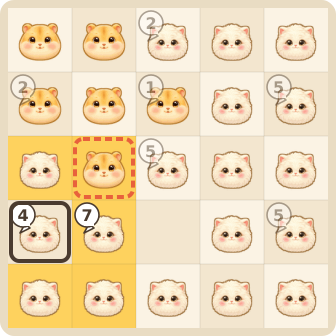
6. The hamster with a 2 on the left edge has one hamster beside it and needs one more. Only the top-left corner is empty, so it is a hamster.7. The cat with a 4 on the left edge now has its 4 cats, so its last empty square is a hamster.8. That leaves the other blue square for the cat with a 5 in the middle. It is a cat.
Solved: every number matches.
What carries over from minesweeper, and what does not
Carries over: counting what is still missing, clearing the rest of a number that is full, and comparing two numbers that share squares.
Different: the number sits on a pet and counts only its own kind. Hamsters count 4 squares, rabbits only the 4 diagonals, and dogs look in straight lines until another pet blocks the view, so always check who is counting.
Different: a mistake costs one of three hearts instead of the whole game, and the square then shows the right pet. Still, there is never a reason to guess. Every board can be finished by logic.

 How Many Pals? The JoyPlus Soft Planning Team