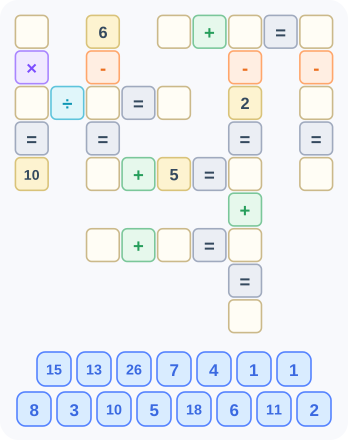
The four hints from the beginner guide (calculate the result, find a pair in the tray, work backwards, and look from the number's side) still do most of the work on Normal boards. But on a 9 by 9 board there are moments when none of them shows a first move. Let's get through those moments on a real board, Normal 9.
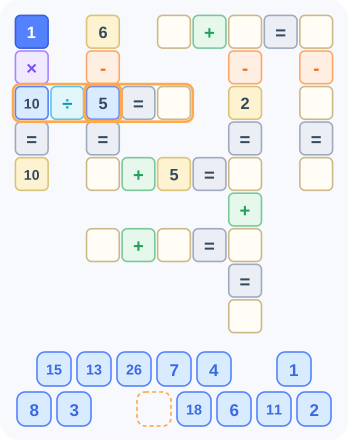
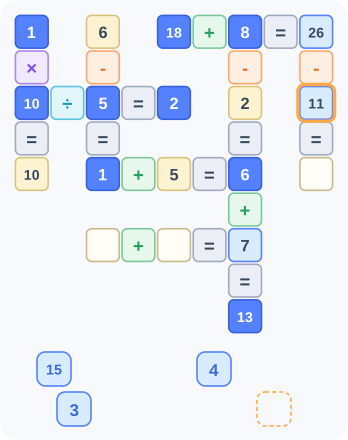
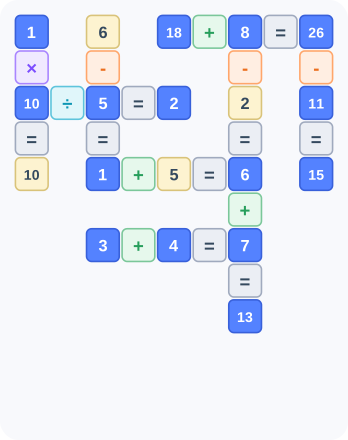
Normal 9. Fifteen empty cells and nine equations. Notice the tray holds two 1s.
At the start, no equation has just one empty cell, and every equation with two empty cells still has more than one possible pair. So we need something new.
Hint 1: At a crossing, compare both equations
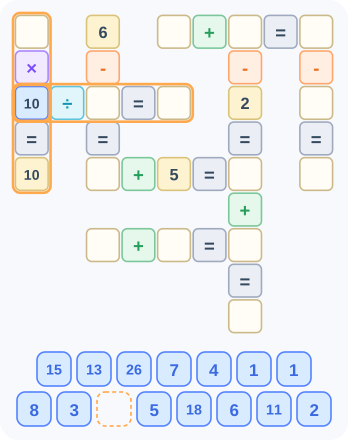
The top-left column reads ? × ? = 10, so its lower cell must divide 10: 1, 2, 5 or 10. That cell also starts the row ? ÷ ? = ?. Starting with 1, 2 or 5 would need the same number two or three times, as in 1 ÷ 1 = 1, 2 ÷ 1 = 2 or 5 ÷ 5 = 1, but the tray has only two 1s and one each of 2 and 5. The only number that suits both equations is 10.
When a cell belongs to two equations, list what each equation allows in that cell, then keep only the numbers on both lists. Each list on its own may be long, but the overlap is often a single number.
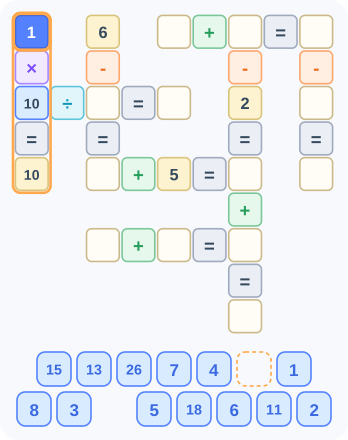
Now the column reads ? × 10 = 10, so the top cell is 1 (working backwards, beginner Hint 3).
Hint 2: Try a number in your head
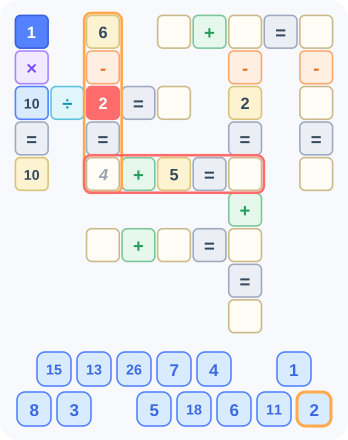
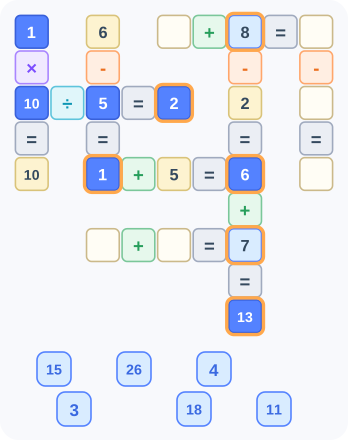
The middle cell of 10 ÷ ? = ? can only be 2 or 5. Try 2 (red cell): the column below gives 6 - 2 = 4, and then the row 4 + 5 = ? needs a 9 (red outline). There is no 9 in the tray, so the cell is not 2.
When a cell is down to two or three candidates and nothing narrows it further, pick one and follow the easy hints in your head. If you end up needing a number that is not in the tray, that candidate is wrong. Do this only in your head. Placing it for real can cost a heart.
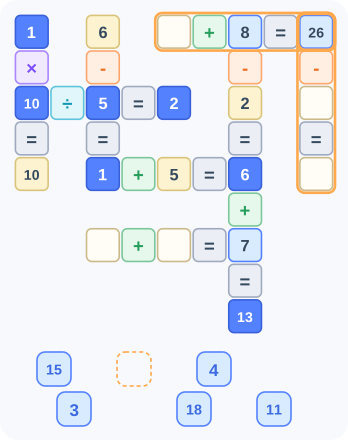
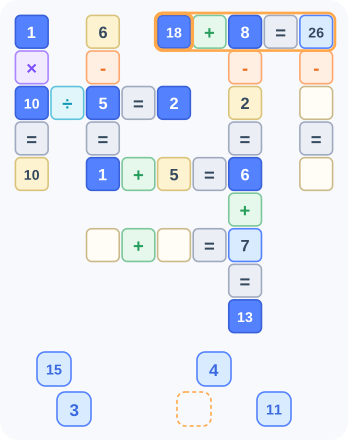
So the middle cell is 5, and 10 ÷ 5 = 2 is also the only pair left in the tray.From here the beginner hints fill six cells in a row: 6 - 5 = 1, 10 ÷ 5 = 2, 1 + 5 = 6, then 8 from ? - 2 = 6, and 7 and 13 from 6 + ? = ?.Now look at the result cell of the top row ? + 8 = ?. On its own this row allows 11 (3 + 8) or 26 (18 + 8). The same cell starts the right column ? - ? = ?, and no remaining pair makes 11 - ? = ? work. The number on both lists is 26 (Hint 1 again).? + 8 = 26, so 18.
Hint 3: When either answer works, just pick one
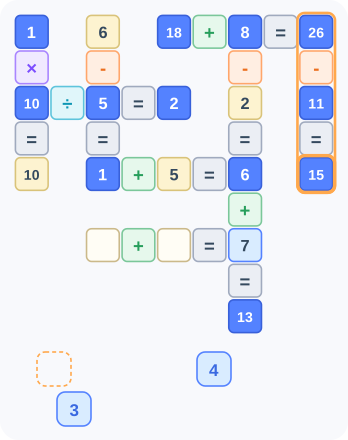
The right column 26 - ? = ? has 11 and 15 left. 26 - 11 = 15 and 26 - 15 = 11 are both correct, and neither cell belongs to another equation, so either way is fine. Here we put 11 on top.
Crossum checks that every equation is true, not that your numbers match a hidden answer key, so some boards have more than one answer. If every hint is used up and two cells are still open, they are usually a pair like this that can swap. Do not agonize over it. When we solved Easy and Normal 1-300 for this guide, we had to choose 653 times, and in 649 of them the other choice could be finished as well. The other 4, all on Normal boards, were spots where only one side works, so if you pick one and later get stuck, go back to that spot and try the other side.
One thing to know: the hint button shows a cell from the arrangement we built the board with. If you went the other way at a spot like this, a hint may take back a number you placed and put it where our version has it.
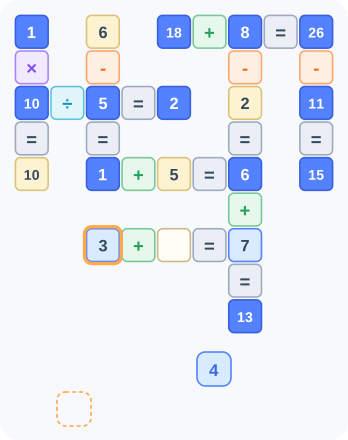
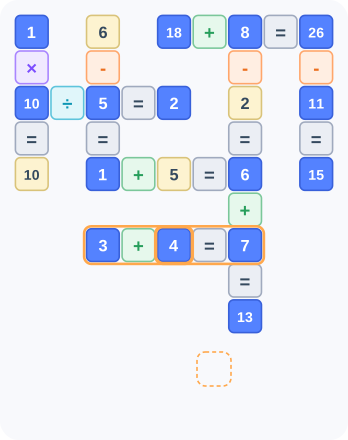
14. 26 - 11 = 15.15. The bottom row ? + ? = 7 works with 3 and 4 in either order. Here 3 goes on the left.16. 3 + ? = 7, so 4.
Solved: all nine equations are correct.
An order to follow on Normal boards
Go once around the board with the beginner hints: equations with one empty cell, then pairs from the tray.
At crossing cells, compare what each equation allows (Hint 1).
For a cell with only two or three candidates, try one in your head (Hint 2).
If two cells that can swap are left at the end, pick either (Hint 3).

 Crossum The JoyPlus Soft Planning Team