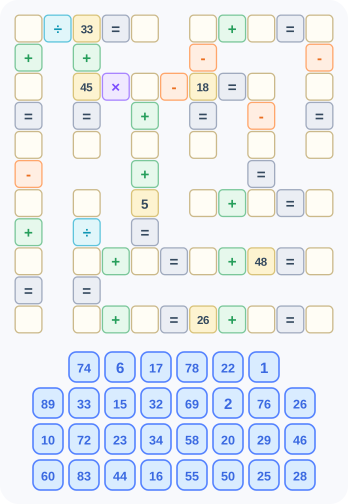
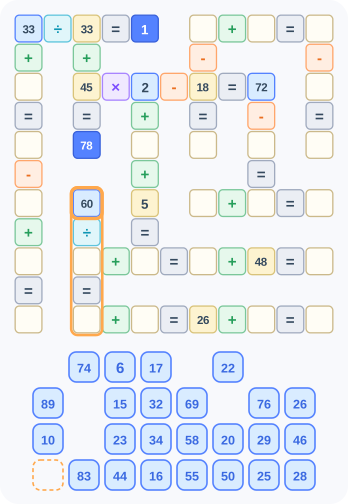
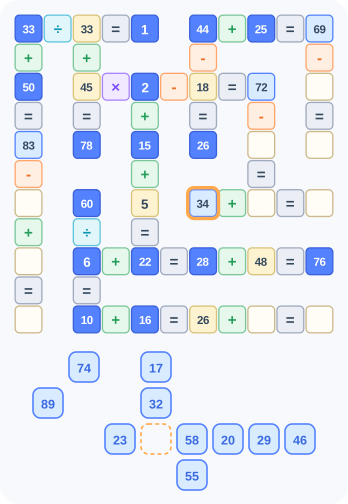
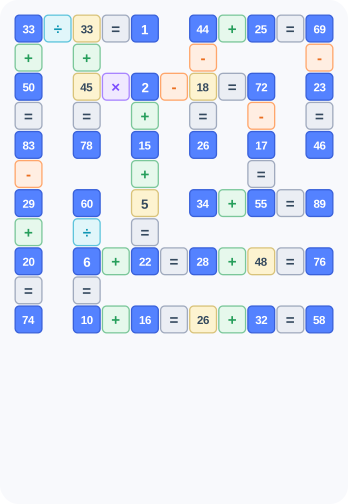
Hard boards are 11 by 11 with up to thirty empty cells, and from stage 101 on they include longer equations with two operators, like A + B × C = D. The hints from the beginner and intermediate guides still work, but there is a lot more to keep track of. Here are four hints for getting all the way through a big board, shown on Hard 141.
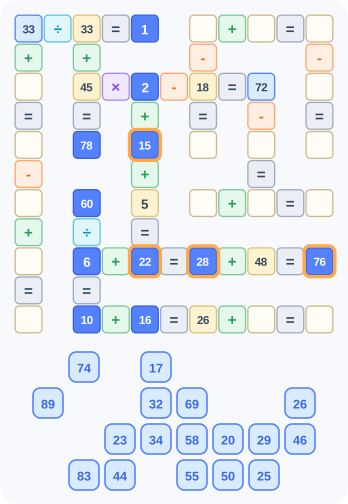
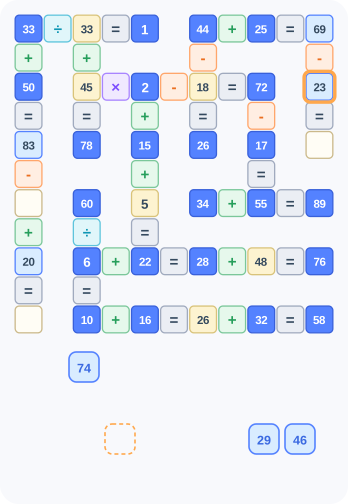
Hard 141. Thirty empty cells and sixteen equations, three of them with two operators.
Warming up
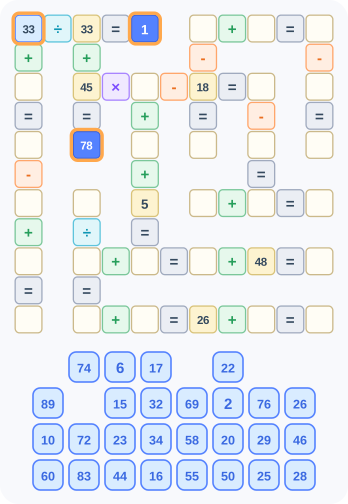
The column under the 33 gives 33 + 45 = 78 (beginner Hint 1). In the top row ? ÷ 33 = ?, the only pair from the tray that fits is 33 ÷ 33 = 1 (beginner Hint 2).
Hint 1: With two operators, multiply and divide first
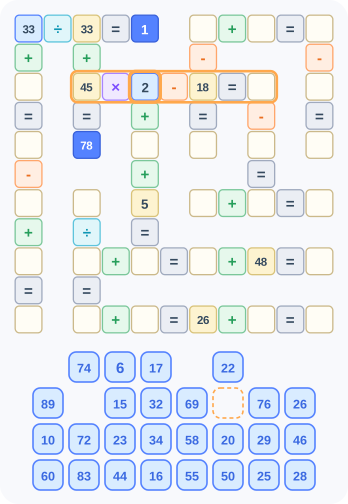
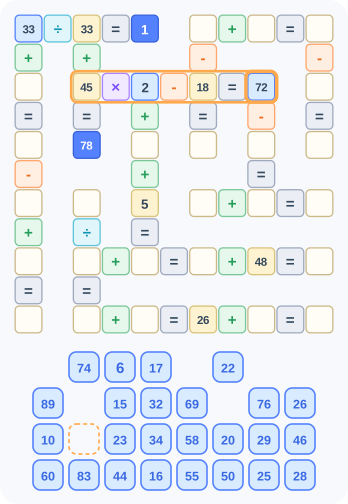
The row that starts with 45 reads 45 × ? - 18 = ?. The multiplication comes first, so 45 times the missing number, minus 18, has to be in the tray. The only number that works is 2, giving 72. Even 3 would already make 45 × 3 - 18 = 117.
An equation with two operators is not worked out strictly from left to right. Multiplication and division go first, then addition and subtraction from the left. 45 × 2 - 18 is 90 - 18 = 72, and 2 + 3 × 4 is 14, not 20. Group the multiplication in your head first, and a long equation behaves just like a short one.
45 × 2 - 18 = 72.
Hint 2: The cell every pair agrees on
The column ? ÷ ? = ? in the lower left, below the 78, is next. Two arrangements from the tray fit: 60 ÷ 6 = 10 and 60 ÷ 10 = 6. We do not know the bottom two cells yet, but in both cases the top cell is 60.
When you look for pairs in the tray (beginner Hint 2) and find more than one, do not move on yet. If some cell gets the same number in every pair, that cell is settled.
Hint 3: Follow a trial all the way
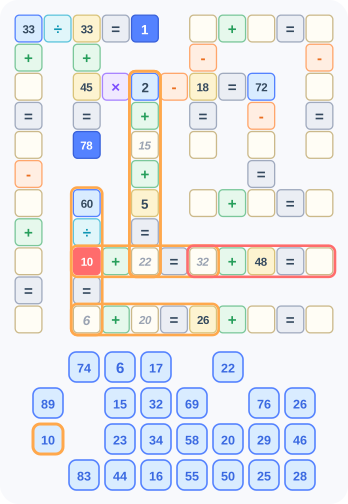
Try 10 in the middle cell of that column (red cell). Then 60 ÷ 10 = 6, 6 + ? = 26 gives 20, and 22, 15 and 32 follow one after another (grey numbers). Then 32 + 48 = ? needs an 80, and there is no 80 in the tray. So the cell is 6, not 10.
In the intermediate guide a trial broke down after a step or two. On Hard boards you sometimes have to follow it for five or six cells before it fails. If it is hard to hold in your head, write it down on paper. This trial is the longest of the three on this board.
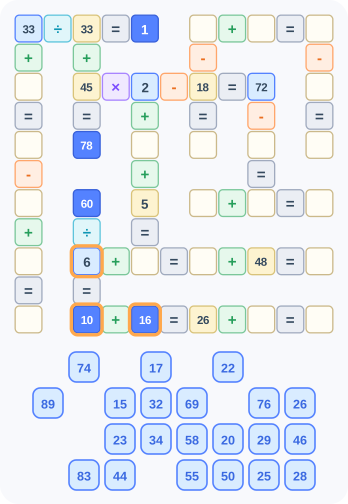
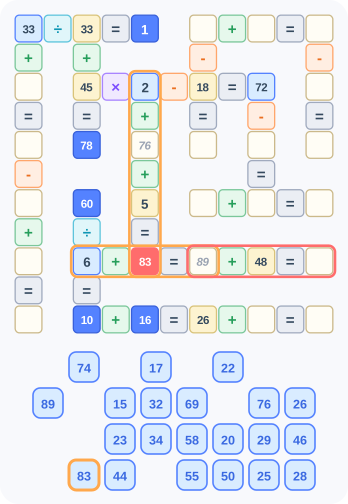
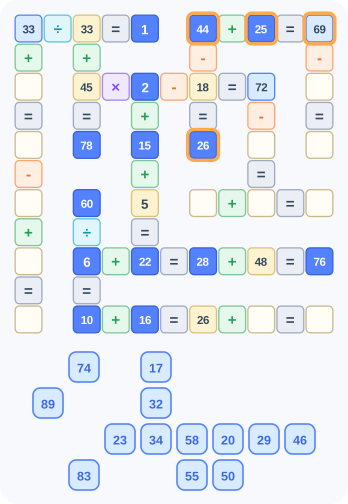
So it is 6, then 60 ÷ 6 = 10, and 16 from 10 + ? = 26.In the row 6 + ? = ?, the empty middle cell can be 22 or 83. Try 83: the column 2 + ? + 5 = 83 needs 76, the row gives 6 + 83 = 89, and then 89 + 48 = 137, which is not in the tray (results never go above 99).With 22 placed: 2 + ? + 5 = 22 gives 15, then 6 + 22 = 28 and 28 + 48 = 76.The first cell of the top row ? + ? = ? is 44 or 50 according to the column ? - 18 = ?, but no remaining pair finishes a row that starts with 50. So 44 - 18 = 26 and 44 + 25 = 69 (intermediate Hint 1).
Hint 4: Numbers you have to save
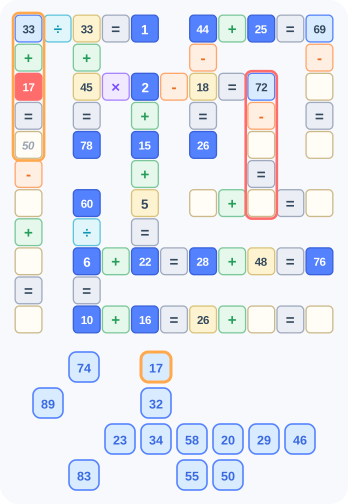
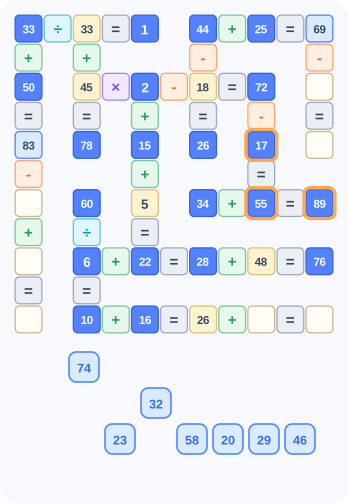
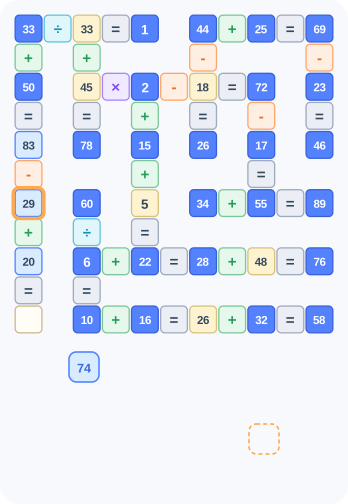
In the left column 33 + ? = ?, the empty middle cell can be 17 or 50. Try 17 (red cell): 33 + 17 = 50 follows. But in the column 72 - ? = ? on the right, the only pair left in the tray is 17 and 55 (red outline). Using 17 here would leave that equation without an answer, so the 17 has to be saved for it.
Each tray number can be used only once. If a trial shows that a number is needed by another equation, it cannot go here. On Hard boards this kind of dead end is common, so when a large equation has only one pair left, remember which numbers it is holding on to.
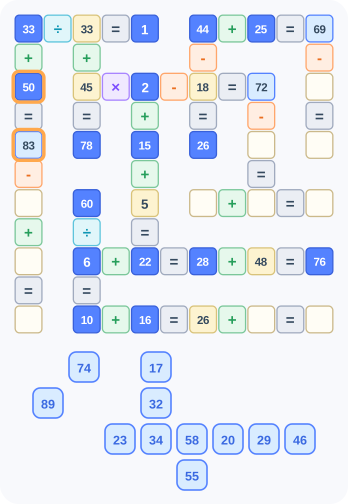
So it is 50, and 33 + 50 = 83.
Big numbers have few places to go
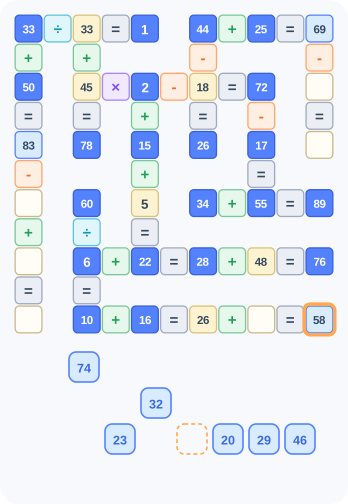
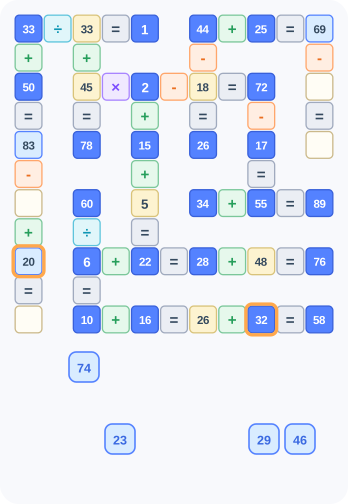
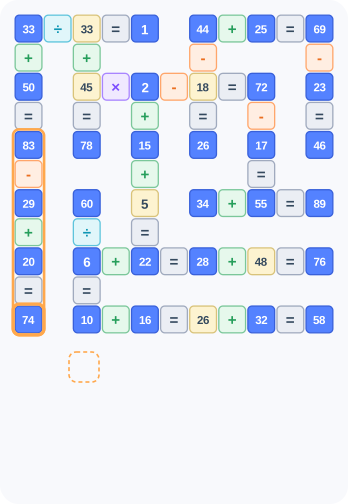
The 34 fits only the first cell of the row ? + ? = ? in the middle right. In 69 - ? or 72 - ? its partner would be 35 or 38, which are not in the tray, and none of the other empty cells can take it either (beginner Hint 4).34 + 55 = 89, and 72 - 17 = 55.The 58 also has only one place, the result of 26 + ? = ? in the bottom row.26 + 32 = 58. The long left column 83 - ? + ? = ? has two arrangements (83 - 29 + 20 = 74 and 83 - 74 + 20 = 29), but the third cell is 20 in both (Hint 2).
The end: cells that can swap
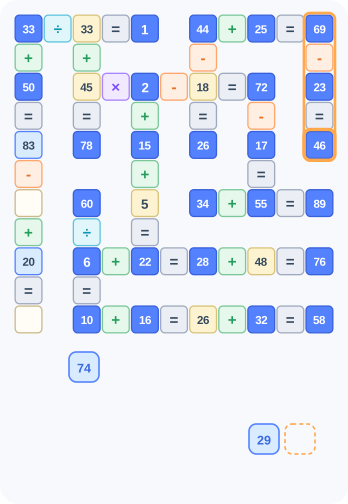
30. The right column 69 - ? = ? works with 23 and 46 either way round (intermediate Hint 3).31. 69 - 23 = 46.32. The long left column also works with 29 or 74 in its second cell.33. 83 - 29 + 20 = 74.
Solved: thirty cells filled and all sixteen equations correct.
We solved Hard 1-200 in the same order (beginner hints, then crossing cells, trials and choices). Only 21 of the 200 boards had a single answer; the other 179 had at least one spot where numbers can swap. Just 4 boards could be finished without any trial or choice. A trial broke down after 3 cells on average (6 times in 10 within 2 cells), and the longest took 22. We had to choose 436 times. In 421 of them either side worked, and in 15 only one side did, so if a choice leads you into a dead end, go back to that spot and take the other side.
An order to follow on Hard boards
Go around with the easy hints first. On a big board they still fill most cells.
In equations with two operators, group the multiplication and division first (Hint 1).
If a tray search finds several pairs, look for a cell they all agree on (Hint 2).
Follow trials all the way, on paper if needed (Hint 3), and watch for numbers another equation needs (Hint 4).
Leave the swappable pairs for the end and pick either.

 Crossum The JoyPlus Soft Planning Team