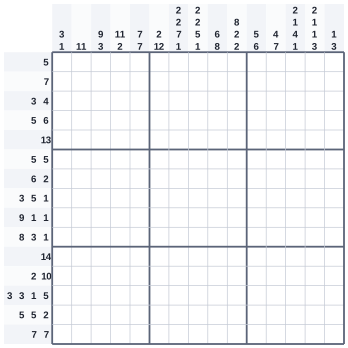
If you have read the beginner guide, you know the four basic hints: lines that fill completely, big numbers that overlap, pushing runs from the squares you know, and putting X on a finished line. In theory those four solve every board. On a 15 x 15 board, though, a line like "2 2 5 1" is a lot to push around in your head. Experienced players look for shapes instead, little patterns that give the answer at a glance. Let's solve Normal 14 together and meet three of them.
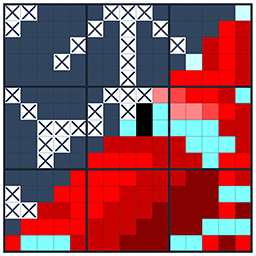
Normal 14. Fifteen rows and fifteen columns. Rows are counted from the top and columns from the left.
Warm-up: lines that fill completely
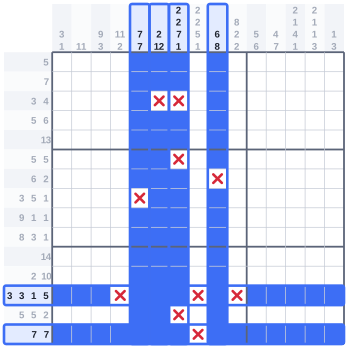
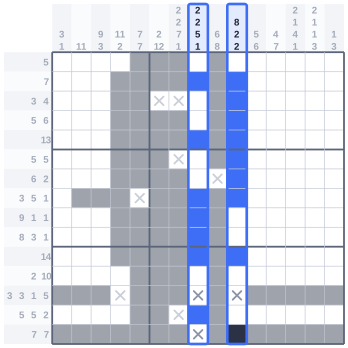
Rows 13 and 15 and columns 5, 6, 7 and 9 add up to exactly 15, so they are decided at once.
Start the way the beginner guide does. Row 13 is 3 + 3 + 1 + 5 plus three gaps, which makes 15. Column 7 is 2 + 2 + 7 + 1 plus three gaps, also 15. Six lines in all fill up this way, and their X marks are what the next hint feeds on.
Hint 1: Split the line at its X marks
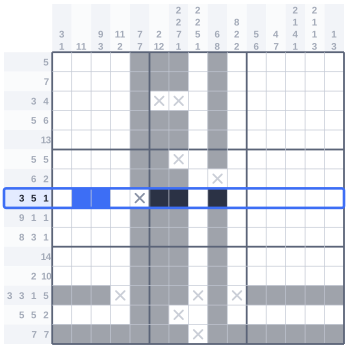
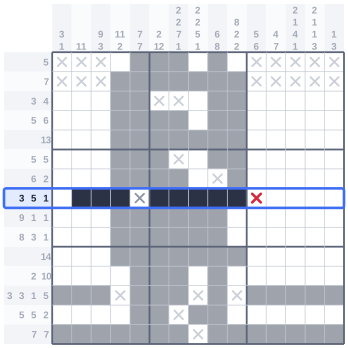
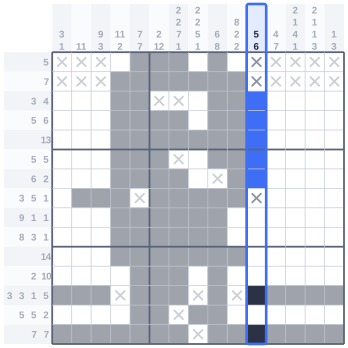
Row 8 (3 5 1) now has an X in column 5. The right part, columns 6 to 15, has ten squares, but 3, 5 and 1 together need 3 + 1 + 5 + 1 + 1 = 11. So the 3 lives in the left part, columns 1 to 4.
An X cuts a line into separate parts, and no run can cross it. So ask which numbers go into which part. Here the left part gets only the 3, because the 5 is longer than four squares. Now the left part is a tiny line of its own: a 3 in four squares, so its middle two squares (columns 2 and 3) are painted. That is the overlap hint from the beginner guide, used on a piece of a line.
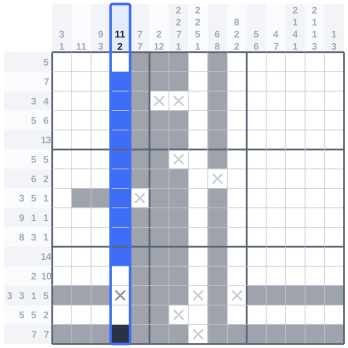
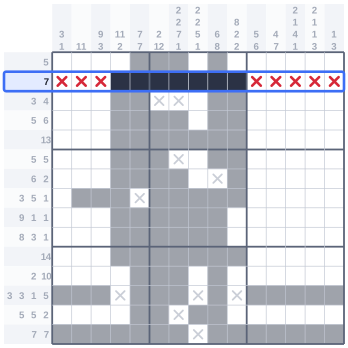
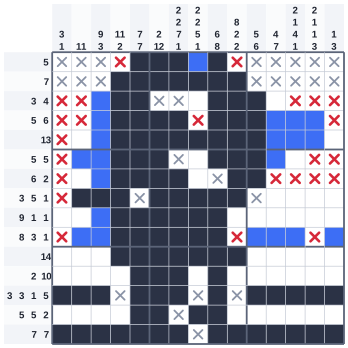
Column 4 (11 2) has an X in row 13 and a painted square in row 15. The 11 fits only in the top part (rows 1 to 12), and the 2 cannot squeeze in next to it (11 + 1 + 2 = 14), so the 2 is at the bottom. An 11 in twelve squares paints rows 2 to 11.Column 8 (2 2 5 1): row 14 is a one-square part, and only the 1 fits there. The 2, 2 and 5 share rows 1 to 12 with one spare square, so rows 2, 5 and 8 to 11 are painted. Column 10 (8 2 2) works the same way: the last 2 takes the bottom part, and the 8 and the 2 overlap in the top.A beginner hint in between: row 2 now has its seven squares, so the rest of row 2 is X.
Hint 2: Gaps too small for any number
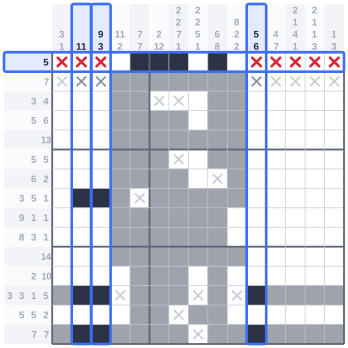
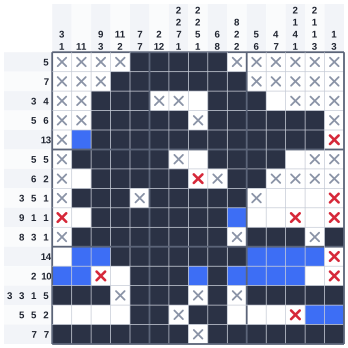
The X marks in row 2 leave the top-left corner cut off. Column 2 (11) has a single square above the X, column 3 (9 3) and column 11 (5 6) too. Row 1 (5) is left with a one-square gap in column 1 and a four-square gap in columns 12 to 15. None of these can hold a number, so they are all X.
Look for short gaps between X marks or between an X and the edge. If the gap is shorter than the smallest number in that line and has nothing painted in it, no run can go there, so the whole gap is X. On big boards these little gaps appear everywhere along the edges, and clearing them makes the parts of the line that matter easier to see.
Hint 3: A run as long as the biggest number is finished
Row 8 (3 5 1) now has five painted squares in a row, columns 6 to 10. Nothing in this row is longer than 5, so this run is complete and column 11 gets an X. (Column 5 already has one.)
When a run of painted squares is as long as the biggest number in its line, it cannot grow any more. Put an X at both ends. You do not even need to know which 5 it is when a line has two of them. This X is often the one that splits the crossing line in two and starts Hint 1 again.
That is exactly what happens in column 11 (5 6). X marks in rows 1, 2 and 8 leave rows 3 to 7, five squares, and rows 9 to 15. The 6 does not fit in five squares, and the 5 and the 6 together are too long for the bottom part, so the 5 fills rows 3 to 7 exactly.
The rest: all the hints together
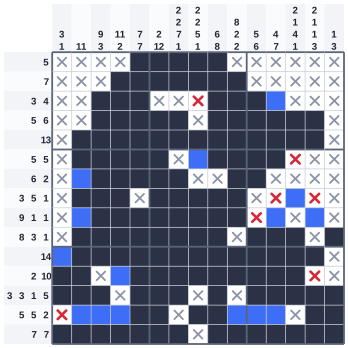
9. With so many X marks, rows 1 to 10 can be pushed left and right easily (beginner Hint 3). Column 1 also loses a one-square part to Hint 1.10. Hint 3 caps the 9 in column 3 and the 5 in column 8, and rows 11 and 12 fill in.11. Finished lines get X (beginner Hint 4), and the last few squares fall into place.
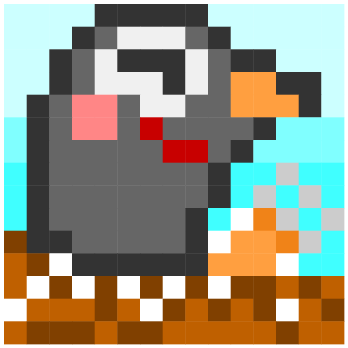
Solved! The finished board turns into a full-color mole.
Habits for Normal boards
Start with lines that fill completely and with big numbers that overlap, just like on small boards.
Every time an X lands in the middle of a line, ask which numbers fit on each side (Hint 1).
Sweep the edges for gaps too short for the smallest number (Hint 2).
When a run reaches the length of the biggest number, cap both ends with X (Hint 3).
Each X you add is new information for the crossing line. Follow it there.

 Nonogram The JoyPlus Soft Planning Team