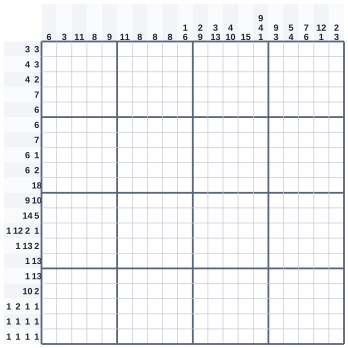
Hard boards are 20 x 20. The beginner hints and the three from the intermediate guide (split a line at its X marks, clear tiny gaps, cap a run as long as the biggest number) still do most of the work. What changes is the middle of the game: a line ends up with painted squares in two or three places, and before you can use them you have to know which number each one belongs to. Let's solve Hard 23 together. The first few pictures are a warm-up with hints you already know.
Hard 23. Twenty rows and twenty columns. Rows are counted from the top and columns from the left.
Warm-up
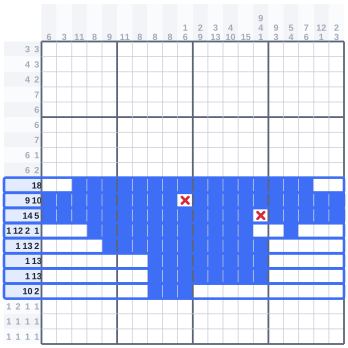
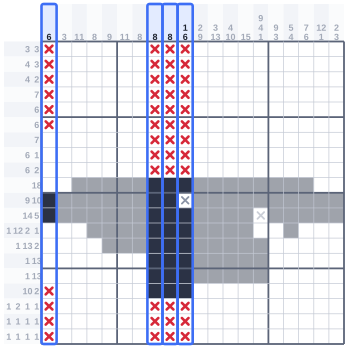
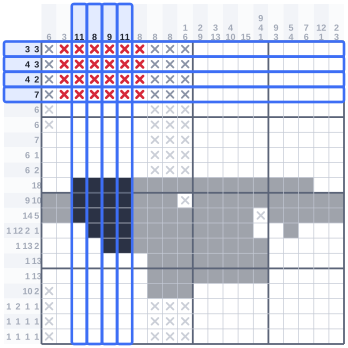
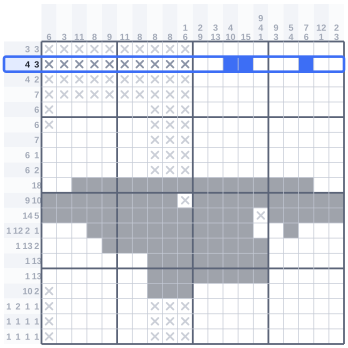
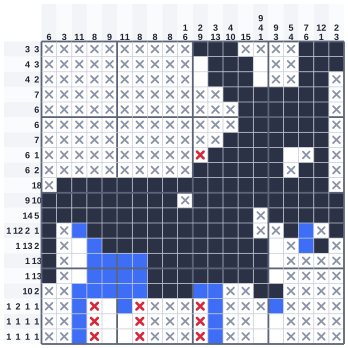
Rows 11 (9 10) and 12 (14 5) add up to exactly 20. Rows 10 and 13 to 17 have big numbers that overlap in the middle.Columns 8 and 9 now have their 8, and column 10 has its 1 and 6, so the rest is X. Column 1 (6) has rows 11 and 12 painted, so the 6 cannot reach rows 1 to 6 or 17 to 20.Those X marks box in the top-left corner. Row 4 (7) has a six-square gap between column 1 and column 8, too short for its 7, and the short gaps around it go the same way (Hint 2 of the intermediate guide).Row 2 (4 3) is now only ten squares long, columns 11 to 20. 4 + 1 + 3 = 8, two spare, so columns 13 and 14 of the 4 and column 18 of the 3 are painted.
Hint 1: One number, one run
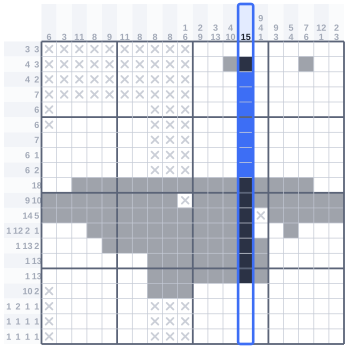
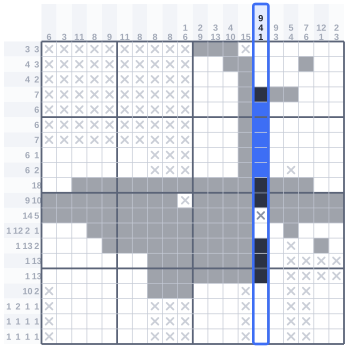
Column 14 has a single number, 15. Row 2 is painted, and so are rows 10 to 16. They all belong to the same 15, so every square between them, rows 3 to 9, is painted too.
When a line has only one number, every painted square in it is part of that one run. A run has no holes, so fill in everything between the highest and the lowest painted square. It sounds simple, but on a 20-square column the two squares can be far apart, and this one move can paint seven squares at once.
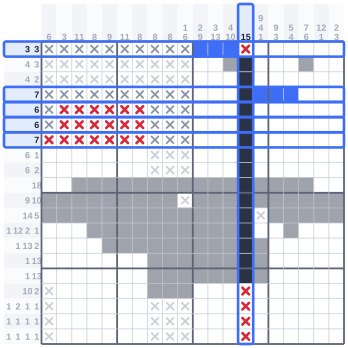
Column 14 now has all 15 squares, so the rest is X. That X splits row 1 (3 3): the right part is only six squares, too short for both 3s, so the first 3 fills columns 11 to 13. Rows 5, 6 and 7 each have one number and a painted square on the right, so their left parts are X.
Hint 2: Which number does this run belong to?
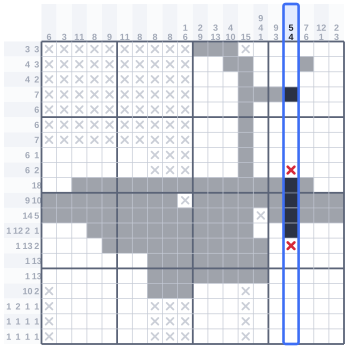
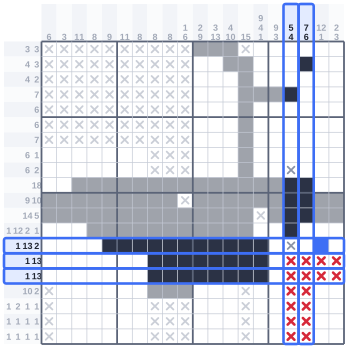
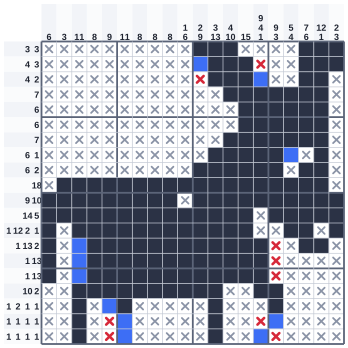
Column 17 (5 4) has a painted square in row 4 and four painted squares in rows 10 to 13. The square in row 4 is the highest one, so it belongs to the first number, the 5. The four squares below cannot be that 5 too: rows 4 to 13 are ten squares, far longer than 5. So they are the 4, and the 4 is already complete. Rows 9 and 14 get X.
On big boards it is common to see a run that is exactly as long as one of the numbers, but not the biggest one, so the intermediate Hint 3 does not apply. Ask which number it can belong to. Numbers stay in order, so the highest painted square belongs to the first number, the next separate run to the first or the second, and so on. Check whether the earlier number could stretch that far. When only one number is left for the run and the run already has that length, cap both ends.
Below the finished 4, column 17 has no numbers left, so rows 15 to 20 are X. That splits rows 14, 15 and 16, and their right ends fall into place with the intermediate hints.
Hint 3: Two pieces of the same number
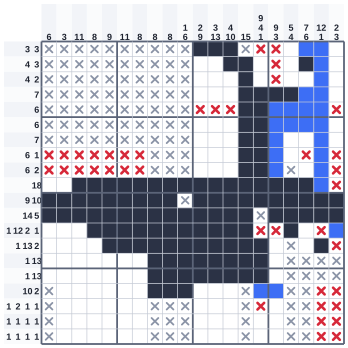
Column 15 (9 4 1) has a square in row 4, two in rows 10 and 11, an X in row 12 and three in rows 14 to 16. If rows 10 and 11 were the 4, the three squares below the X would have to be the 1, which is impossible. So rows 10 and 11 belong to the 9, and so does row 4, the highest square. Both pieces are the same 9, so rows 5 to 9 between them are painted.
This is Hint 1 for lines with several numbers. Work out the owner of each painted piece the same way as in Hint 2. If two pieces turn out to belong to the same number, that number has no holes, so the squares between them are painted. Often the reason is a piece further along the line that is too long for the later numbers, like the three squares here that could never be a 1.
The rest: the three hints again
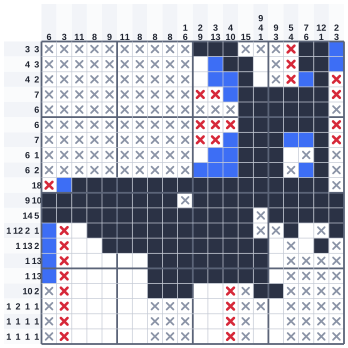
10. Column 16 joins its squares into the 9 the same way (Hint 3), and runs whose number is known get X as soon as they are full (Hint 2).11. The top right closes. Columns 12 and 13 join their long runs (Hint 3), and the 1s at the start of rows 13 to 16 go into column 1.12. The legs: column 6 has one number and joins its squares (Hint 1), rows 15 to 17 join theirs (Hint 3), and rows 18 to 20 place their single squares.13. Column 3 joins its 11 (Hint 1), and the last squares follow.
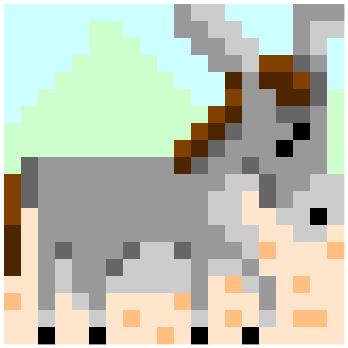
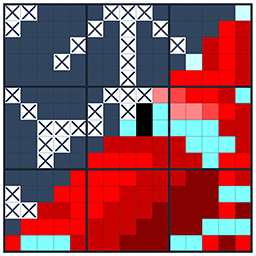
Solved! The finished board turns into a full-color donkey.
Habits for Hard boards
Clear the easy parts first: full lines, overlaps and tiny gaps. On Hard boards they still do most of the work.
In a line with one number, fill every square between the painted ones (Hint 1).
When a line has painted squares in several places, label each piece with the number it can belong to. Go in order from the start of the line (Hint 2).
A piece that has its number and its full length gets X at both ends (Hint 2). Two pieces with the same number get joined (Hint 3).
If you are unsure which number a piece belongs to, look at the pieces after it. A piece that is too long for every later number settles a lot.

 Nonogram The JoyPlus Soft Planning Team